

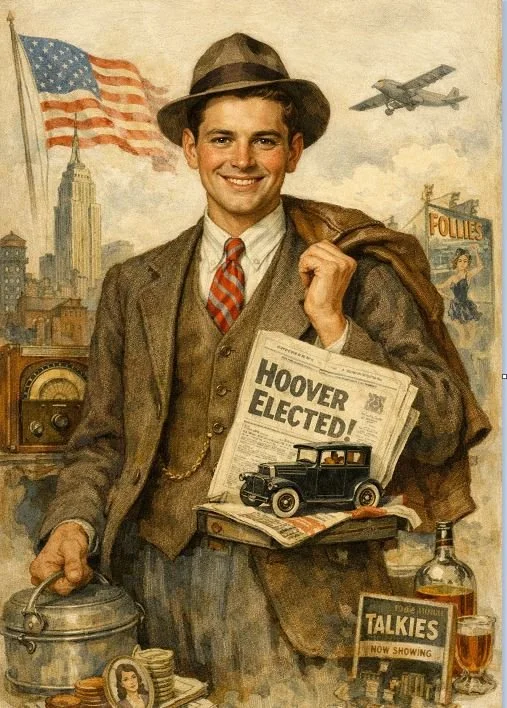
The Average American, 1930
By David Kennedy
Freedom from Fear: The American People in Depression and War, 1929-1945 (Oxford History of the United States) pp. 41- 42
[1] As 1930 opened, the investigators compiling Recent Social Trends were just beginning their researches. Taking their presidential mission seriously, they were much interested in that typical American. His age, they determined, was twenty-six. (He would have been a male, this hypothetically abstracted individual, as men continued to outnumber women in the United States until 1950, when the effects of declining immigration, heavily male, and rising maternal survival rates made women for the first time a numerical majority in the American population.) He had been born during the first term of Theodore Roosevelt’s presidency, in the midst of the progressive reform ferment. His birth occurred about the time that Japan launched a surprise attack on the Russian fleet at Port Arthur, China—an attack that led to war, Russian defeat, and the first Russian revolution (in 1905) and that heralded Japan’s ambition to play the great-power game. About a million immigrants—virtually none of them Japanese, thanks to a distasteful ‘‘gentlemen’s agreement’’ by which the Japanese government grudgingly agreed to limit its export of people—entered the United States in every year of his early childhood. He had reached the age of ten when World War I broke out in 1914, and he had just become a teenager—a term, indeed a concept, not yet in wide use—when President Woodrow Wilson took the United States into the war. By the time the fighting ended, in 1918, he had left the eighth grade and completed his formal schooling. (He would have completed it some three years earlier if he had been black.)
[2] He was too young to have seen battle, but he soon concluded that the whole business of sending American troops to Europe was a useless, colossal blunder and an inexcusable departure from the venerable American doctrine of isolation. The spectacle of wretched Europeans going bankrupt in Germany, knuckling under to a fascist dictator in Italy, welcoming Bolsheviks—Bolsheviks!—in Russia, and then, to top it off, refusing to pay their war debts to the United States confirmed the wisdom of traditional isolationism, so far as he was concerned. Raised in the country without flush toilets or electric lighting, as the1920s opened he moved to the city, to an apartment miraculously plumbed and wired. In the streets he encountered the abundant and exotic offspring of all those immigrants who had arrived when he was a baby.
[3] Together they entered the new era when their country was transiting, bumpily, without blueprints or forethought, from an agricultural to an industrial economy, from values of simple rural frugality to values of flamboyant urban consumerism, and, however much the idea was resisted, from provincial isolationism to inevitable international involvement. Jobs were plentiful for the moment and paid good wages. With hard work he was making a little more than a hundred dollars a month. He had been laid off several times in the preceding years but had built a small cushion of savings at his bank to tide him over when unemployment hit again, as he knew it must. The stock market had just crashed, but it seemed to be recovering, and in any case he owned no stocks—for that matter, neither did anybody he knew. Evenings he ‘‘radioed.’ ’Weekends he went to the movies, better now that they had sound. Some-times he broke the law and lifted a glass. On his one day a week off, he took a drive in the car that he was buying on the installment plan. He was living better than his parents had ever dreamed of living. He was young and vigorous; times were good, and the future promised to be still better. He had just cast his first presidential vote, in 1928, for Herbert Hoover, the most competent man in America, maybe in the world. In that same year he married a girl three years younger than he. She gave up her job to have their first baby. They started to think of buying a house, perhaps in one of the new suburbs. Life was just beginning.
And their world was about to come apart.
Timeline: The World of the “Average American,” 1904–1930
1904–1905 — Progressive Era Reform Climate
The “average American” is born during the presidency of Theodore Roosevelt, a period marked by federal reform efforts addressing trusts, labor conditions, and consumer protections.
1904–1905 — Russo-Japanese War Begins
Japan’s surprise attack at Battle of Port Arthur signals its emergence as a global power and contributes to unrest that leads to the Russian Revolution of 1905.
Early 1900s — Peak Immigration Era
Roughly one million immigrants enter the United States annually, transforming urban demographics and fueling industrial labor growth while reshaping American cities.
1907–1908 — Gentlemen's Agreement of 1907
The United States limits Japanese immigration through diplomatic pressure rather than formal legislation, reflecting rising nativist attitudes.
1914 — World War I Begins in Europe
At age ten, the “average American” witnesses the outbreak of a war that initially reinforces U.S. neutrality traditions.
1917 — U.S. Entry into World War I
President Woodrow Wilson leads the United States into the conflict, marking a major departure from longstanding isolationist policy.
1918 — End of World War I
The war’s conclusion shapes widespread American skepticism about foreign entanglements and contributes to interwar isolationist sentiment.
Early 1920s — Rise of Isolationism
Disillusionment with European instability—economic collapse in Germany, fascism in Italy under Benito Mussolini, and Bolshevik rule after the Russian Revolution—reinforces resistance to international involvement.
1920s — Urbanization and Industrial Transition
The United States shifts rapidly:
from rural to urban living
from agricultural to industrial employment
from frugality to consumer culture
Electrification, indoor plumbing, automobiles, radios, and motion pictures reshape daily life.
Late 1920s — Expansion of Consumer Credit Economy
Installment buying allows working-class Americans to purchase automobiles and household goods, signaling rising living standards but also growing financial risk.
1928 — 1928 United States presidential election
The average voter supports Herbert Hoover, widely viewed at the time as a capable technocratic leader promising continued prosperity.
1929 — Wall Street Crash of 1929
The collapse of stock prices marks the beginning of the Great Depression, though its full consequences are not yet immediately visible to many Americans.
1930 — Early Depression Uncertainty
Despite layoffs and instability, many citizens still expect recovery, reflecting lingering optimism before the crisis deepens dramatically after 1930.