
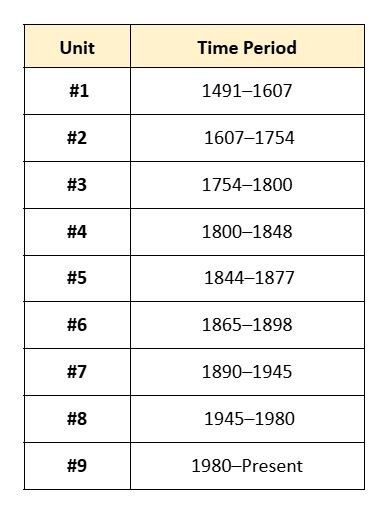
What do the students need to KNOW? What content and themes will be covered in class? A.P. United States History and CHS American History are framed around NINE CONTENT UNITS(Time Periods) covering 1491 to the Present.
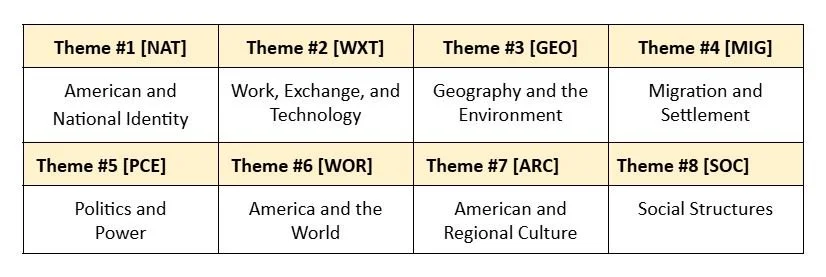
What content and themes will be covered in class? A.P. United States History and CHS American History integrates EIGHT CORES THEMES to build a conceptual understanding of content.
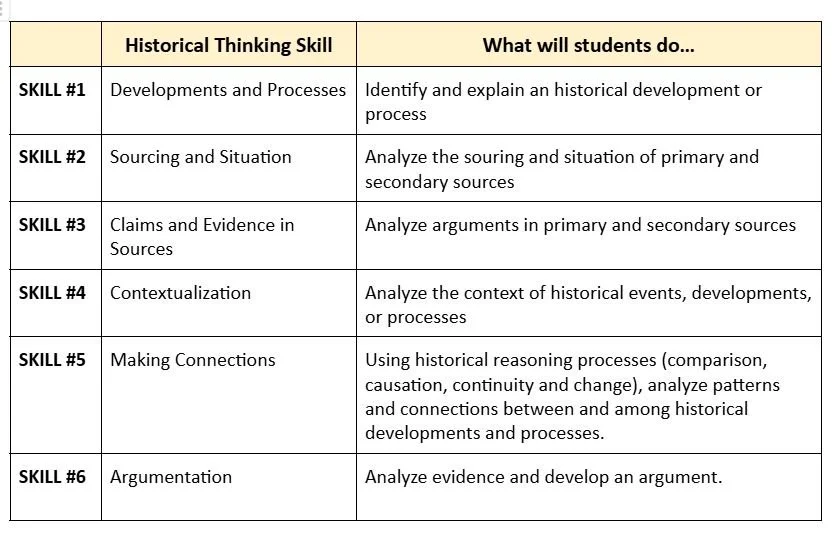
What do the students need to DO with the content and concepts you covered in class?
The historical thinking skills listed below describe what honors level history students should be able to do while exploring course concepts. The table that follows presents these skills, which students should develop during a college level survey course in American History.
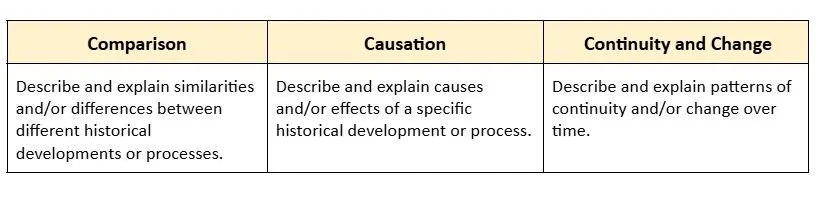
How will students SHOW their understanding of the content and concepts we cover in class? Through the Historical Reasoning Process
Proper Nouns mentioned in AP Concept Outline - The concept outline for AP U.S. History presents the course content organized by key concepts rather than in sequential units. The concept outline references key content. The following list contains individuals, events and ideas specifically mention in the AP Concept outline
The Columbian Exchange
joint-stock company
Encomienda system
Metacom’s War (King Philip’sWar) in New England
Pueblo Revolt
First Great Awakening
European Enlightenment
Protestant evangelicalism
mercantilist economic policy
Indentured servants [Bacon’s Rebellion]
Chattel slavery
Seven Years’ War (the French and Indian War)
Benjamin Franklin
George Washington’s military leadership
Thomas Paine’s Common Sense
Declaration of Independence
“Republican Motherhood”
Declaration ofIndependence reverberated in France, Haiti, and Latin America
The Constitutional Convention - Ratification Conventions
Anti-Federalists vs. Federalists
Federalist Papers (Alexander Hamilton and James Madison)
Bill of Rights
George Washington
Northwest Ordinance
George Washington’s Farewell Address
Democrats (Andrew Jackson) vs Whigs (Henry Clay)
Louisiana Purchase
Second Great Awakening
Seneca Falls Convention
American Indian removal
Monroe Doctrine
Missouri Compromise
Manifest Destiny
Mexican–American War
The American Civil War
Antebellum Immigration patterns - Ireland and Germany
Anti-Catholic nativist movement
Free-Soil movement
Mexican Cession
Compromise of 1850
Kansas–Nebraska Act
Dred Scott decision
Second Party System
Republican Party
Abraham Lincoln
Emancipation Proclamation
Gettysburg Address
13th, 14th and 15th amendments
Reconstruction
laissez-faire policies
“New South”
People’s (Populist) Party
The Gilded Age
Social Darwinism
Gospel of Wealth
Social Gospel
Jane Addams
Plessy v. Ferguson
Spanish–American War
Progressive Era
World War I
League of Nations
Woodrow Wilson
American Expeditionary Forces
Treaty of Versailles
The Great Migration
Harlem Renaissance
Red Scare
Great Depression
Franklin Roosevelt’s New Deal
Pearl Harbor
Internment of Japanese Americans
D-Day invasion
The Sun Belt region
Korea and Vietnam
Martin Luther King Jr
Brown v. Board of Education [Thurgood Marshall]
Liberalism
Lyndon Johnson’s Great Society
Civil Rights Act of 1964
Ronald Reagan
September 11, 2001 - World Trade Center and the Pentagon