

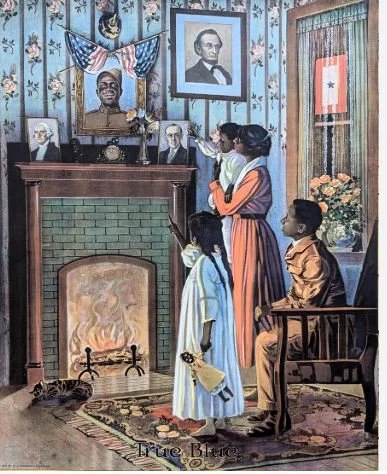
In 1918, at the height of World War I, an illustration titled True Blue depicted something that should have been unremarkable: an African American family honoring their son’s military service beneath the American flag. Yet in the Jim Crow South, this image was considered politically dangerous—and in some places effectively censored.
Why? Because the image quietly asserted a powerful claim: Black Americans were not only loyal citizens—they were entitled to the full rights of citizenship.
A Patriotic Image That Challenged the Racial Order
At first glance, True Blue appears sentimental and conventional. A mother places flowers beneath a portrait of her son in uniform. A blue star service flag hangs nearby. Portraits of George Washington and Abraham Lincoln frame the scene. The home is warm, orderly, and dignified.
But in 1918 America—especially in the South—this was not a neutral image.
It directly challenged assumptions embedded in Jim Crow society by presenting African Americans as:
patriotic citizens
honorable military families
participants in the nation’s founding ideals
members of the American middle class
That visual argument alone carried political weight.
As one analysis notes, the illustration was controversial not because it was inflammatory in tone, but because “a dignified, patriotic image of a Black family was itself a radical political statement.”
Black Military Service and the “Close Ranks” Strategy
By 1918, approximately 380,000 African Americans had served in the U.S. armed forces. Most served in segregated units and were often assigned to labor battalions rather than combat roles.
Despite discrimination, leaders like W.E.B. Du Bois urged Black Americans to support the war effort through the “Close Ranks” strategy—temporarily setting aside demands for civil rights in hopes that wartime sacrifice would strengthen claims to equality afterward.
True Blue reflects this moment of strategic patriotism. It visually argues:
Service → Sacrifice → Citizenship
The image suggests that participation in national defense placed African Americans firmly within the American political tradition represented by Washington and Lincoln.
Why White Southern Audiences Found the Image Threatening For many white Southerners committed to maintaining racial hierarchy, True Blue carried unsettling implications.
The illustration:
1. Depicted Black dignity and middle-class life - Mainstream white newspapers rarely published images portraying African Americans as respectable citizens. This challenged entrenched stereotypes used to justify segregation.
2. Linked Black soldiers to founding ideals - By visually associating African American service with Washington and Lincoln, the illustration suggested continuity between Black sacrifice and the nation’s democratic heritage.
3. Claimed full civic belonging - The blue star service flag symbolized participation in national defense. Displaying it in a Black household implicitly asserted equal status with white military families.
4. Anticipated postwar civil rights demands - White leaders feared—correctly—that returning Black veterans would expect expanded political rights after the war. The racial violence of the Red Summer of 1919 reflected backlash against precisely these expectations.
True Blue reminds us that African American patriotism during World War I was not simply an expression of loyalty—it was also a powerful claim to equality in a nation that had yet to honor its own democratic promises. By examining images like this through historical thinking frameworks, students can better understand how service, sacrifice, and citizenship have long been interconnected in the ongoing struggle to define what it means to be fully American. In this way, the document transforms from a wartime illustration into a window on one of the central tensions of modern U.S. history.